Can Your Panel Handle an EV Charger? Service & Load Options
Thinking about an EV charger but only have a 100-amp panel? Learn when you need a service upgrade, load management, or just a lower-amperage setting.
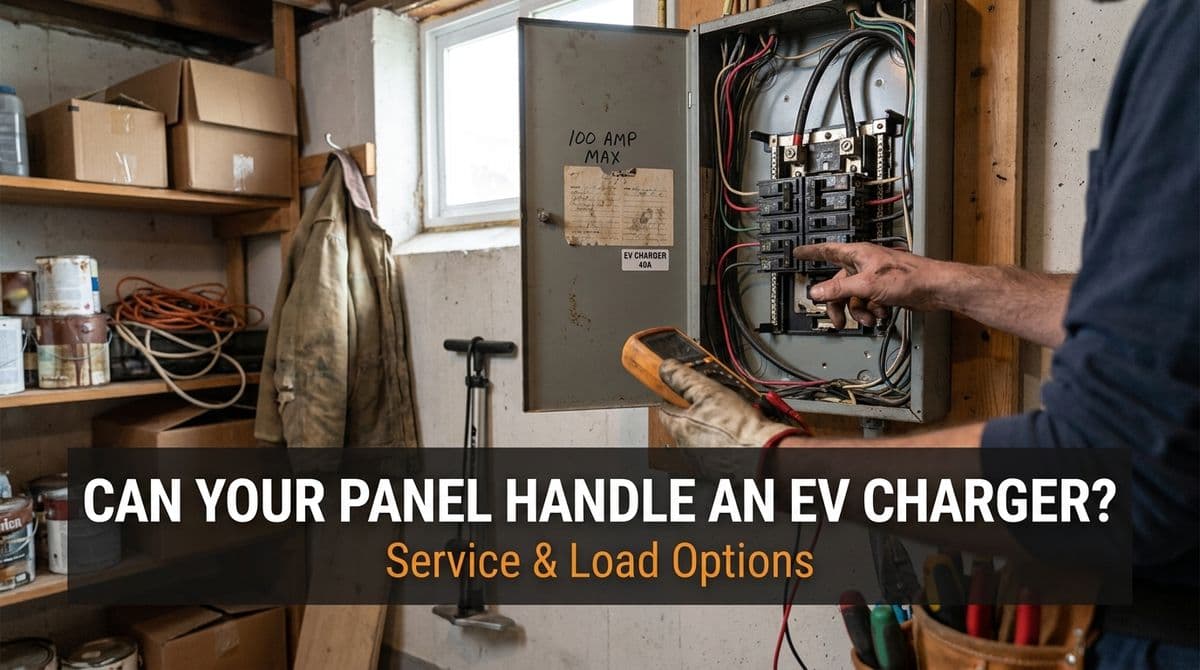
A Recent Call About an EV Charger in a Full-Electric Home
We recently got a call from a customer — let's call him Brian — who wanted a rough estimate to install a Level 2 EV charger in his garage. His electrical panel was already in the garage, it was a 100-amp panel with two open breaker spaces, and the charger location would be only about 15–20 feet away. On paper, it sounded simple.
Brian had already ordered a Grizzl-E Level 2 charger, rated for 40 amps (which typically means a 50-amp breaker and #6 wire). He’d even done some homework and knew it could be limited down to 32 amps if needed. What he really wanted to know was: “Can my panel handle this, or do I need a bigger service or some kind of load management?”
That’s a question we’re getting more and more, so we thought we’d walk through how we approached Brian’s situation — and what you can look for in your own home.
Step One: What’s on Your Panel and What’s in Your House?
When homeowners ask us about EV charger installs, our first questions are always about the electrical service and the big power users in the home. With Brian, we confirmed:
- 100-amp main service
- Panel located in the garage, with two free slots
- Electric water heater
- Electric range
- Electric dryer
From an electrician’s standpoint, that combination — a 100-amp service plus several large electric appliances — is a red flag when you want to add a 40-amp EV charger. The panel might have the physical space for a breaker, but the real question is whether the service capacity is enough for everything running at once.
In many areas, codes and utilities are tightening up the rules around EV chargers. Inspectors often won’t allow “derating” or optimistic assumptions about how little the charger will be used, especially on a smaller 100-amp service that’s already feeding multiple high-draw appliances.
Why a 40-Amp EV Charger Isn’t Just “One More Breaker”
A 40-amp Level 2 charger typically uses a 50-amp circuit. That’s a significant continuous load, because EV chargers are treated as if they might run at full power for hours at a time.
In Brian’s case, we looked at the combined impact of:
- Electric range (can draw a lot when all burners/oven are on)
- Electric dryer
- Electric water heater
- General house loads (lights, outlets, furnace blower, etc.)
- Proposed 40-amp EV charger
When you stack all of those on a 100-amp service, there’s a high probability that a proper load calculation will show the service as undersized for a full 40-amp EV charger. That’s why we told Brian there was a strong chance we’d need a service upgrade or some form of load management.
Option 1: Upgrading to a 200-Amp Service
For many homes like Brian’s, the most straightforward long-term solution is upgrading from a 100-amp to a 200-amp service. That typically means a new meter base, new service panel, and updated grounding and bonding, all sized to handle more load safely.
Benefits of a service upgrade include:
- Room for present and future EV chargers
- Capacity for additional electric appliances (heat pump, hot tub, etc.)
- Improved electrical safety and modern code compliance
A service upgrade is a larger investment than a simple charger circuit, but for homeowners who are “all electric” or planning to add more electric equipment, it’s often the cleanest way to avoid nuisance breaker trips and code issues down the road.
Option 2: Load Management or Load Shedding Devices
If upgrading the entire service isn’t in the budget or doesn’t make sense right now, load management is the next thing we look at. With Brian, we discussed installing a load shedding device or using an EV charger that has built-in load management features.
Here’s what those can do:
- Automatic shut-off or reduction: If the total household draw gets close to the service limit, the device temporarily cuts or reduces power to the EV charger.
- Priority rules: The system can prioritize essential loads (like heat and hot water) over EV charging.
- Code compliance: In many areas, this is how inspectors allow an EV charger on a smaller service without a full upgrade.
We explained to Brian that this kind of setup lets him keep his 100-amp service for now, while still safely adding a Level 2 charger, as long as the total calculated load and the specific device meet local requirements.
Option 3: Dialing Back the Charger Amperage
Brian pointed out that his Grizzl-E unit can be de-rated to 32 amps. That means it would only draw about 32 amps instead of the full 40, and it might be paired with a smaller breaker depending on the manufacturer’s instructions and local codes.
Lowering the charger’s amperage can help in three ways:
- Reduces load on the service: Less current means less strain on a 100-amp panel.
- May avoid a service upgrade: In some situations, a properly de-rated charger plus a good load calculation is enough to pass inspection.
- Still very usable: Many drivers find that a 24–32 amp charge is plenty for overnight charging.
We always emphasize, though, that simply “turning it down” in the app or on the charger isn’t a substitute for a real load calculation and proper breaker sizing. The settings, breaker, and wiring all need to align with the manufacturer’s specs and local code.
Hardwired vs. Plug-In: Why It Matters in a Garage
Another detail Brian brought up was how to connect his Grizzl-E charger. The model he ordered comes with a NEMA 14-50 plug, but in a garage, that usually means the receptacle would need to be GFCI-protected, which adds cost and can introduce nuisance tripping with some chargers.
We often recommend hardwiring units like this when the manufacturer allows it. With many EV chargers, you can open the case, remove the plug connection, and land the conductors directly on terminals. That can eliminate the need for a GFCI receptacle while still meeting code with a properly installed hardwired circuit, depending on local requirements.
How to Tell What You Need for Your EV Charger
If you’re in a similar spot to Brian and wondering what your home can handle, here’s how we suggest approaching it:
- Check your main service size. Look at the main breaker — it will usually say 100A, 150A, or 200A.
- List your big electric loads. Water heater, range, dryer, AC/heat pump, electric heat, hot tub, etc.
- Know your charger specs. Maximum amperage, recommended breaker size, and whether it can be de-rated.
- Have a licensed electrician do a load calculation. This is the only reliable way to know if you need a service upgrade, a load management device, or if a lower-amperage setting is enough.
With Brian, our next step was to pull the exact spec sheet for his charger and schedule a visit so we could perform a proper load calculation and look over his existing service. From there, we could give him a clear, code-compliant path forward — whether that meant a 200-amp upgrade, a load shedding solution, or a reduced-amperage setup that still meets his daily driving needs.
If you’re thinking about an EV charger and aren’t sure what your panel can handle, we’re always happy to walk through your options and design a solution that’s safe, practical, and ready for the future.