Why Your Garage Circuit Keeps Tripping or Losing Power
Garage outlets keep tripping or losing power? Learn safe DIY checks, common causes, and when to add dedicated circuits for tools, sump pumps, and radon fans.
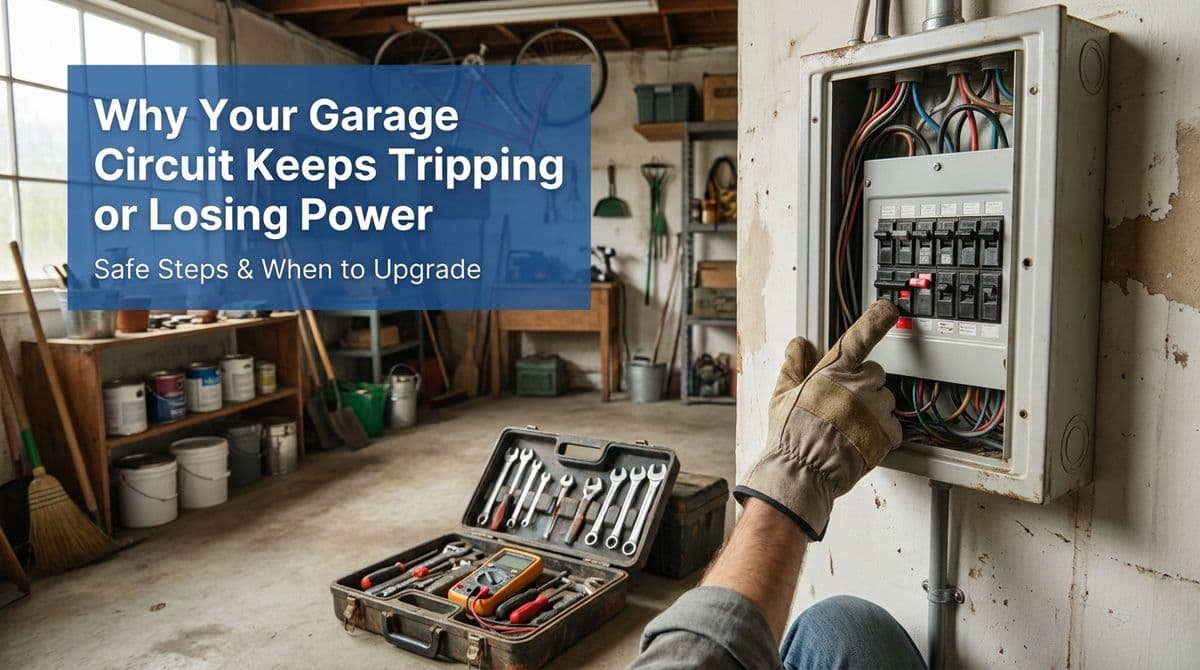
Why Your Garage Circuit Keeps Dying on You
We recently got a call from a homeowner — let’s call him Tom — who was in the middle of a weekend project when everything in his garage suddenly went dead.
Tom was running his table saw when it just stopped cold. Naturally, he assumed it was the saw, so he fiddled with it, tried a different outlet, and eventually realized the problem wasn’t the tool at all — the whole string of garage outlets had lost power. No power at the first outlet, no power at the next, nothing upstream or downstream.
He walked back to his panel, tried cycling the breaker off and on. Still nothing. That’s when he called us.
As we talked, it became clear his situation was one we see a lot in older homes: the garage outlets were on a “mystery” circuit that also fed his gas water heater controls, a radon fan, a sump pump, and a few lights. In other words, way too much important equipment hanging off one questionable line.
Using Tom’s call as an example, let’s walk through why a garage circuit might keep tripping or losing power, some safe troubleshooting steps you can try, and when it’s time to add dedicated circuits for key equipment.
Common Reasons Your Garage Circuit Trips or Loses Power
1. Overloaded Circuit (Too Much on One Breaker)
In Tom’s case, a single circuit was feeding:
- Multiple garage outlets
- Gas water heater controls or fan
- Radon fan
- Sump pump
- Possibly some lights
Individually, those loads don’t sound huge, but when you start a table saw (or any motor-driven tool), it draws a high inrush current. If you stack that on top of pumps and fans that cycle on and off, you can easily overload a 15A or 20A circuit — especially in an older home with questionable wiring splices.
Signs you may be overloading a circuit:
- Breaker trips when you start a tool or plug in a second device
- Lights dim when a motor starts
- Multiple rooms, outlets, or equipment lose power together
2. Tripped GFCI or Bad Device on the Circuit
Many garage and outdoor circuits are (or should be) protected by a GFCI outlet or breaker. If that GFCI trips, everything “downstream” will lose power. Sometimes the GFCI is not even in the garage — it might be:
- In a bathroom
- In the basement
- At an exterior outlet
Other times, a single bad outlet, loose backstab connection, or worn device can interrupt power to every outlet that follows it in the chain.
3. Loose Connections or Aging Wiring
In older homes especially, we often find:
- Loose wirenuts in junction boxes
- Backstabbed receptacles that have failed
- Corroded or overheated connections
These can cause intermittent power loss, “dead” sections of a circuit, or breakers that get hot and trip under what should be normal use.
Safe Troubleshooting Steps You Can Try Yourself
Before you grab a screwdriver, here are a few safe, non-invasive checks you can do, similar to what we walked Tom through on the phone.
1. Check the Breaker Properly
Sometimes a tripped breaker doesn’t look obviously “off.”
- Open your panel door and identify the breaker that feeds the garage.
- Firmly switch it all the way to the OFF position.
- Then flip it back to the ON position.
If it immediately trips again when you plug something in, stop right there — that’s a sign of a deeper problem or overload.
2. Hunt for a Tripped GFCI
If your garage outlets are dead but the breaker seems fine:
- Look for any outlets with TEST and RESET buttons in:
- Garage
- Bathrooms
- Basement
- Exterior walls
Press the RESET button firmly. If it clicks and power comes back, you’ve found the culprit. If the GFCI won’t reset or trips again immediately, that’s when we recommend having an electrician investigate.
3. Unplug Everything, Then Test
If the breaker holds with everything unplugged, but trips as soon as you run a particular tool or appliance, you’re probably overloading or there may be a fault in that device.
- With the breaker OFF, unplug all tools and devices from the garage outlets.
- Turn the breaker ON.
- Plug in and test one device at a time, starting with small loads.
If a single outlet or section of outlets never comes back, even while others work, that’s a red flag that you may have a bad device or connection in the middle of the run — something best left to a pro to diagnose.
When You Should Add Dedicated Circuits
As Tom and I talked through his setup, he mentioned a new panel with room for additional breakers. That’s actually great news — it means we can often fix these problems the right way instead of just “band-aiding” them.
Here are some clear signs it’s time for dedicated circuits:
1. Critical Equipment on a Shared Circuit
You should strongly consider dedicated circuits for:
- Sump pumps (you don’t want these losing power mid-storm)
- Radon fans (important for indoor air safety)
- Water heaters (even gas units have controls/fans)
- Garage door openers in some cases
When these are tied into the same circuit as your outlets and tools, every time you flip on the saw or compressor, you’re gambling with equipment you rely on for safety and comfort.
2. Regular Nuisance Tripping During Normal Use
If your breaker trips any time you:
- Run a table saw and a shop vac together
- Use a space heater in the garage
- Start an air compressor
…then it’s likely that your usage has outgrown the original wiring design. Adding one or more dedicated 20A circuits for tools or heat can make your garage much safer and more functional.
What We Typically Do on a Visit Like Tom’s
On a service call like this, our process usually looks like:
- Map out which outlets, lights, and equipment are on the affected circuit
- Test the breaker, GFCIs, and outlets for proper voltage and wiring
- Locate and repair any failed devices or loose connections
- Recommend separating critical equipment (sump, radon, water heater) onto dedicated circuits
- Install new breakers and run new home runs from the panel where needed
The end result is what Tom was really after: a garage where his tools work reliably, and important equipment like his sump pump and radon fan aren’t at the mercy of a tripping breaker.
When to Call an Electrician
If you’ve tried the basic steps — checked breakers, reset GFCIs, unplugged everything — and your garage still has dead outlets or recurring trips, it’s time to bring in a licensed electrician.
Any of these are reasons to make that call:
- Burn marks or melted plastic on outlets or the panel
- Breaker that won’t reset or gets hot to the touch
- Repeated tripping when running normal loads
- Critical equipment (sump, radon fan, water heater) losing power
If your situation sounds anything like Tom’s, we can come out, walk through your setup with you, and design a safer, more reliable circuit layout for your garage and mechanical equipment.