Knob and Tube Wiring: Safety, Cost & Timelines
Buying or selling an older home with knob and tube wiring? Learn how it impacts safety, insurance, cost, and timelines so you can negotiate with confidence.
Helping Buyers Navigate Knob and Tube Wiring
We recently got a call from a realtor — we’ll call her Kelly — who was helping buyers purchase an older home in St. Paul. Their inspection had just come back, and the inspector estimated that about 90% of the home still had knob and tube wiring.
Kelly’s clients were nervous. Was the house unsafe? Would their insurance company balk? How much would it cost to rewire, and how long would they be living in a construction zone? They needed clear answers fast so they could negotiate before their inspection deadline.
We walked Kelly through the same things we discuss with any homebuyer, seller, or realtor dealing with knob and tube. In this post, we want to share that guidance with you.
What Knob and Tube Wiring Actually Is
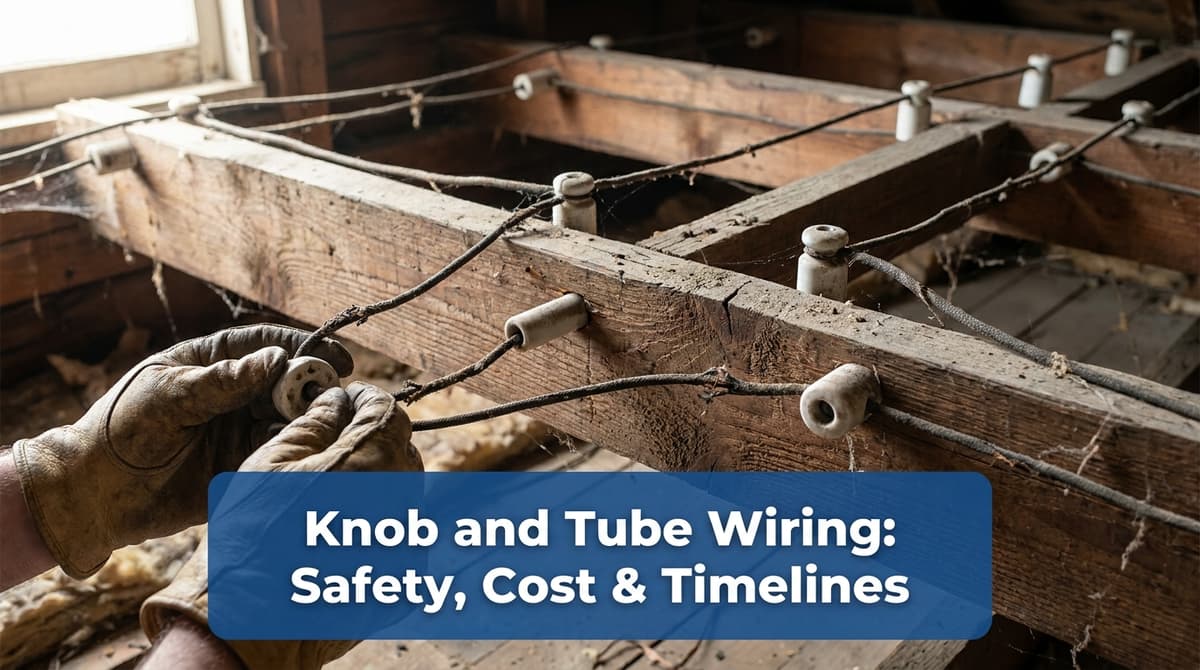
Most knob and tube (K&T) wiring in our area dates from the early 1900s up through the 1940s. Instead of cables, you have individual wires run through porcelain tubes in framing and supported on porcelain knobs.
When it was installed properly and left untouched, knob and tube wasn’t inherently “bad” for its time. The issues come from age, changes, and today’s electrical loads:
- Insulation breakdown – Old cloth or rubber insulation can dry out, crack, or fall off.
- Hidden splices – DIY tie-ins and junctions buried in walls or ceilings are extremely common.
- Undersized for modern loads – Circuits never anticipated today’s appliances, electronics, or HVAC equipment.
- Interaction with insulation – Original K&T assumed open air around the wires; modern insulation packed around them is a red flag for many insurers and inspectors.
Is Knob and Tube Wiring Always Unsafe?
One of Kelly’s first questions was, “Is the house even safe to live in?” Our answer: it depends on the condition and how it’s been modified, but it is always something to take seriously.
We look at:
- Visible deterioration of wire insulation
- Overfusing (for example, 30A fuses on 14-gauge wire)
- Evidence of overheating at devices or in the panel
- Mixed wiring methods where newer wiring is tied into old K&T
- Insulation contact in attics or walls where K&T was never meant to be buried
For buyers and sellers, the key point is this: even if the wiring hasn’t caused a problem yet, many insurers, lenders, and inspectors treat extensive K&T as a defect that must be addressed.
How Knob and Tube Affects Insurance and Lending
We told Kelly what we tell most clients: call your insurance agent early. Some insurers will:
- Refuse to write a new policy if more than a certain percentage of the home has K&T
- Require written documentation that the system has been decommissioned or replaced
- Offer coverage only if there is a clear plan and timeline to rewire
On our side, we routinely:
- Provide written estimates and scope of work you can share with insurers and lenders
- Coordinate permit and inspection details with the local authority
- Issue completion letters once the K&T has been removed from service and new wiring is in place
Having that documentation can make negotiations and underwriting go much smoother.
Cost Factors: Why We Need a Walkthrough
Kelly understandably wanted a ballpark number: “Are we talking thousands or tens of thousands?” The honest answer is that rewiring costs vary widely, and we won’t guess without seeing the home.
Here’s what affects cost the most:
- Size and layout of the home – A compact 1.5-story bungalow is very different from a 2.5-story with additions.
- Access – Unfinished basements and open attics lower cost; finished spaces and plaster walls increase labor.
- How much has already been updated – Sometimes only lighting circuits are K&T; sometimes almost everything is original.
- Panel and service capacity – If the electrical service is undersized, that may also need to be upgraded.
For Kelly’s clients, we scheduled a thorough walkthrough during their inspection window so we could give a written estimate they could use in negotiations.
Typical Timelines for Replacing Knob and Tube
Another big question in any transaction is, “How long will this take?” While every project is different, we generally see:
- Smaller 2–3 bedroom homes with good access: about 3–5 working days
- Larger 2.5-story homes or heavily finished basements: 1–2 weeks
- Very complex or phased projects (for occupied homes): 2+ weeks, sometimes in stages
For Kelly’s St. Paul listing, we explained that we could typically complete a house like that within about a week after permits are issued, assuming reasonable access and no major surprises behind the walls.
What the Rewiring Process Looks Like
Homeowners usually picture every wall ripped open. That’s not how we approach it. Our goal is to minimize disruption while fully decommissioning the K&T.
In a typical project, we will:
- Pull the necessary permits and coordinate inspections.
- Map existing circuits and identify all areas fed by knob and tube.
- Plan routes through basements, attics, and closets to reduce wall damage.
- Install new grounded wiring and modern devices to meet current code.
- Disconnect and abandon old K&T wiring so it’s no longer energized.
- Work in phases to keep as much of the home functional as possible.
There will usually be some small drywall or plaster patches. We keep openings as small and strategic as possible and let you know exactly what to expect before we start.
Real-World Examples: Bungalow vs. Big 2.5-Story
To give Kelly context, we shared two recent projects:
Smaller Bungalow
We rewired a 1.5-story bungalow with an unfinished basement and open attic. Most of the K&T was for lighting and a few outlets. Because we had great access, we finished in four days with minimal wall openings.
Larger 2.5-Story
We also handled a 2.5-story home with finished basement and plaster walls throughout. Almost all branch circuits were K&T. That project took just under two weeks, done in phases so the family could stay in the home with planned power interruptions.
Kelly’s client’s home fell somewhere between those two, so we were able to give a realistic timeline range for their negotiations.
Common Knob and Tube FAQs
Can we leave some knob and tube in place?
From a code perspective, existing K&T that is in good condition and not modified may be “grandfathered,” but insurers and buyers often do not accept that. In many transactions, the expectation is that all active K&T feeding living spaces will be removed from service.
Will you need to open all the walls?
No. We use basements, attics, and closets as much as possible. That said, we usually need some targeted access holes to fish new wiring. We review those locations with you in advance.
Can this be done after closing if the buyer prefers?
Yes, but buyers should confirm with their insurer and lender first. Sometimes we provide a signed contract and timeline that lets the deal move forward, with the work scheduled soon after closing.
Who should be in the walkthrough – buyer or seller?
Ideally, whoever will be paying for the work should be present, along with the realtor. That way everyone hears the same information about scope, cost, and timeline.
How We Help Buyers, Sellers, and Realtors Decide
When we met Kelly at the property, our goals were simple: clarify safety, provide solid numbers, and outline realistic timelines. With that information, her clients could decide whether to:
- Ask the sellers to complete the work before closing
- Request a credit or price reduction to handle it after closing
- Walk away if the scope didn’t fit their budget or comfort level
If you’re buying or selling an older home and an inspection reveals knob and tube wiring, we’re happy to perform a walkthrough, explain what you’re really dealing with, and give you the documentation you need to make a confident decision.