Upgrading Your Home from 60 to 100 Amp Electrical Service
Still on 60 amp service? Learn when a 100 amp upgrade makes sense, what’s involved, and how to get your home ready for a smooth, code-compliant project.
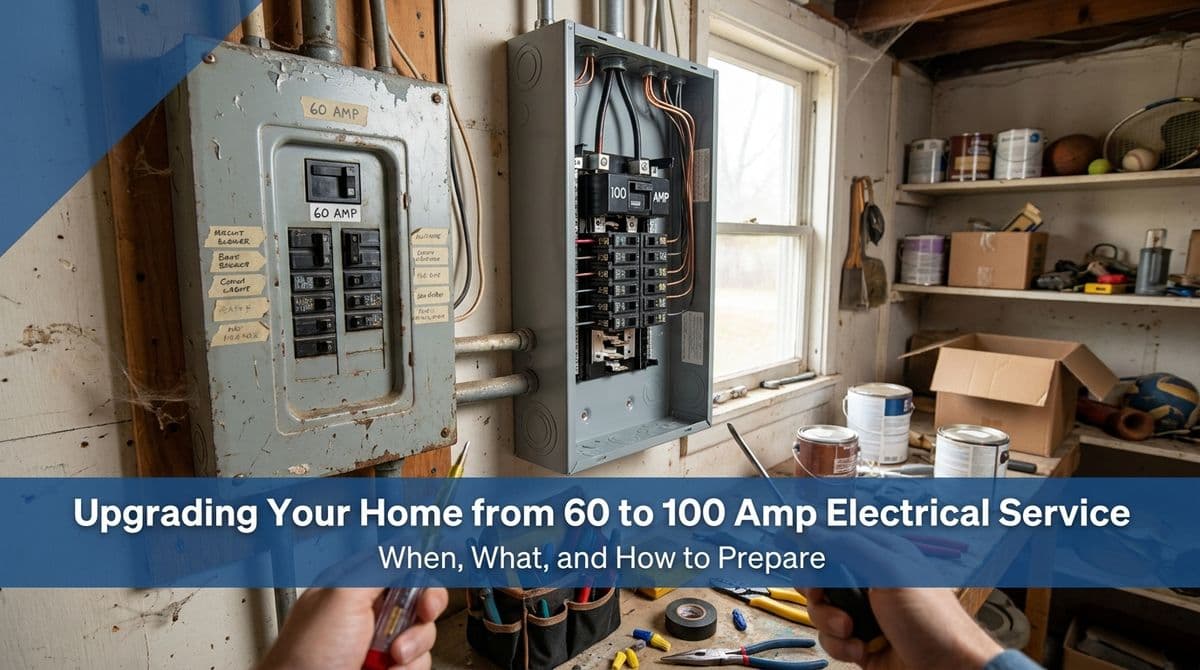
“We’ve Been Told the House Is Set Up for 100 Amps…”
We recently got a call from a homeowner — let’s call her Sara — who said something we hear all the time:
“We’re sitting at like 60 amps to the home right now, and we’ve been told in the past that we’re set up for 100 amps. We just need to get that breaker replaced. Can you give us a quote?”
Situations like Sara’s are really common in older homes. The original service was installed decades ago at 60 amps, the utility or an inspector mentioned that the house could support 100 amps, and now the homeowner is wondering what it actually takes to make that jump.
In this post, we want to walk you through when a 60 amp to 100 amp upgrade makes sense, what’s actually involved, and how to get your home ready so the project goes smoothly.
Do You Really Need to Upgrade from 60 Amp to 100 Amp?
When we visit a home like Sara’s, the first thing we look at is need. A 60 amp service isn’t automatically unsafe, but it can be undersized for how we use electricity today.
Common signs your 60 amp service is too small
Here are some of the red flags we often see:
- Frequent tripped breakers or blown fuses when you run the microwave, space heaters, or window AC units.
- Lights dimming when large appliances start up (furnace, AC, well pump, etc.).
- Limited circuits so multiple rooms share the same breaker and overload it easily.
- Plans to add big new loads like central AC, an electric vehicle charger, hot tub, or electric range.
- Insurance or inspection issues — some insurers and buyers are wary of 60 amp service.
When we walked through these questions with Sara, she mentioned wanting to add more kitchen appliances and possibly an EV charger in the future. That already put her current 60 amp service on the edge.
When 100 amp service is usually enough
For many small to mid-size homes without all-electric heating, 100 amps is a solid, modern baseline. It’s typically enough for:
- Standard gas furnace and AC
- Electric dryer and electric range (in many cases)
- Normal lighting and receptacle loads
- Small extras like a hot tub or workshop, if planned carefully
If you’re planning a very large addition, full electric heating, or multiple EV chargers, we may talk about 200 amp service instead. But for homeowners like Sara, 100 amps is usually the right next step.
“We Were Told the House Is Set Up for 100 Amps” — What That Really Means
We hear this line a lot, and it can be a little misleading. When someone says the home is “set up for 100 amps,” it might mean:
- The meter socket and service entrance cable are already rated for 100 amps.
- The grounding system was upgraded previously.
- There’s space for a 100 amp main breaker in the existing panel.
But other times it turns out only part of the system is sized for 100 amps, and the rest still needs to be updated. That’s why, like with Sara, we almost always recommend a quick on-site visit before giving a firm quote.
During that visit, we typically check:
- The service drop or lateral (wires from the utility to your home)
- Meter socket rating and condition
- Service entrance cable size and routing
- Main panel rating and available spaces
- Grounding and bonding (ground rods, water pipe bond, etc.)
Only after we’ve seen these pieces can we confirm whether it truly is a “simple” main breaker change, or whether more of the service needs to be upgraded.
What’s Actually Involved in a 60 to 100 Amp Upgrade?
For a typical home, the upgrade can range from a straightforward panel/main breaker changeout to a full service replacement. Here’s what we walk through with homeowners.
1. Permits and coordination with the power company
Service upgrades are not a DIY project. We handle:
- Electrical permit with your city or county
- Coordination with the utility to disconnect and reconnect power
- Inspection scheduling as required
For Sara, one of her first questions was about cost and whether there was a fee just for us to come out. We explained that estimates are free, but permits and utility work are part of the project price, not a surprise add-on later.
2. Panel and service equipment work
Depending on what we find, work may include:
- Replacing the main breaker and/or panel with a 100 amp rated unit
- Upgrading the meter socket and service entrance cable to 100 amp rated components
- Cleaning up existing wiring inside the panel and labeling circuits
Sometimes, the panel is in good shape and already rated for 100 amps, and we truly can just change the main breaker. Other times the safest route is a full new panel and service upgrade, especially if the existing gear is very old or showing signs of overheating or corrosion.
3. Grounding, bonding, and safety updates
We also make sure your system meets current safety codes, which can include:
- Installing or upgrading ground rods
- Bonding to the water service piping (if metal)
- Ensuring neutral and ground are separated in subpanels
These upgrades are about more than just “passing inspection” — they protect you and your electronics from fault currents and lightning surges.
How to Prepare Your Home for an Electrical Service Upgrade
When we booked a same-day estimate with Sara, she asked what she needed to do ahead of time. Here are the simple steps we recommend to every homeowner.
1. Clear access to the panel and meter
Make sure we can easily reach:
- The main electrical panel (no shelves, storage, or appliances blocking it)
- The meter on the outside of the house (trim bushes or move obstacles as needed)
Code requires working space around electrical equipment, and having that clear ahead of time keeps the job on schedule.
2. Plan for a temporary power outage
During the actual upgrade (not just the estimate), your power will be off for several hours. We suggest:
- Planning work for a daytime window when you don’t need major appliances
- Keeping fridge and freezer doors closed as much as possible
- Charging phones and laptops ahead of time
- Letting us know about any medical equipment that needs power
We coordinate with the utility and inspection department to minimize downtime as much as we can.
3. Think about future electrical needs
Before we finalize the scope, we like to ask:
- Are you planning to finish a basement or add a room?
- Thinking about an EV charger in the next few years?
- Dreaming of a hot tub, sauna, or workshop?
It’s often cheaper and easier to plan for those now — for example, by leaving extra panel spaces or adding conduit — than to open everything back up later.
Next Step: Get a Professional Eyes-On Estimate
If you’re like Sara, sitting on a 60 amp service and wondering how hard it would be to move up to 100 amps, the best next step is a quick on-site visit. We can confirm what your home is really set up for, what needs to be changed, and give you a clear, written estimate.
Every home is a little different, but with the right planning, a 60 amp to 100 amp upgrade is a straightforward project that can make your electrical system safer, more reliable, and ready for the way you live today.